Safety inspection of the above-ground heat pipeline structure
Key takeaways
Safety inspection was triggered by a vehicle impact on the structure
Visual checks alone could not detect hidden damage
Laserscanning and photogrammetry enabled precise analysis
Cross-sections and X-ray views revealed structural deformation
Comparison with original geometry ensured accurate assessment
Damage was limited to the support structure, not the pipeline
Results supported repair planning and preventive measures
3D scanning improved inspection efficiency, safety, and accuracy
Introduction into safety inspection
Health and safety are the most important values in our lives. They should always be everyone’s highest priority. Safety inspection is essential to ensure and supervise them.
The term safety inspection covers a very wide range of activities. It usually involves a routine inspection aimed at evaluating potential hazards in the workplace, infrastructure facilities, equipment or documentation. The main purpose of a safety inspection is to prevent accidents and injuries.
However, this does not completely eliminate the risk of an accident occurring. Unfortunately, accidents do sometimes happen, and when they do, a further inspection is necessary.
On this occasion, the inspection conducted by the Geos3D team took place following a car accident involving an aboveground pipeline structure.
Preparation
The aim of the surveys was to inspect a damaged section of pipeline running above the road. This task was carried out using a Leica RTC360 terrestrial laser scanner. A dense point cloud was crucial for obtaining detailed dimensions during post-processing.
Additionally the photogrammetry was also done with DJI M3E drone.
The correct positioning of the scanner stations was of key importance. It was also necessary to prepare the survey area appropriately to ensure safety at all times.
Fieldwork
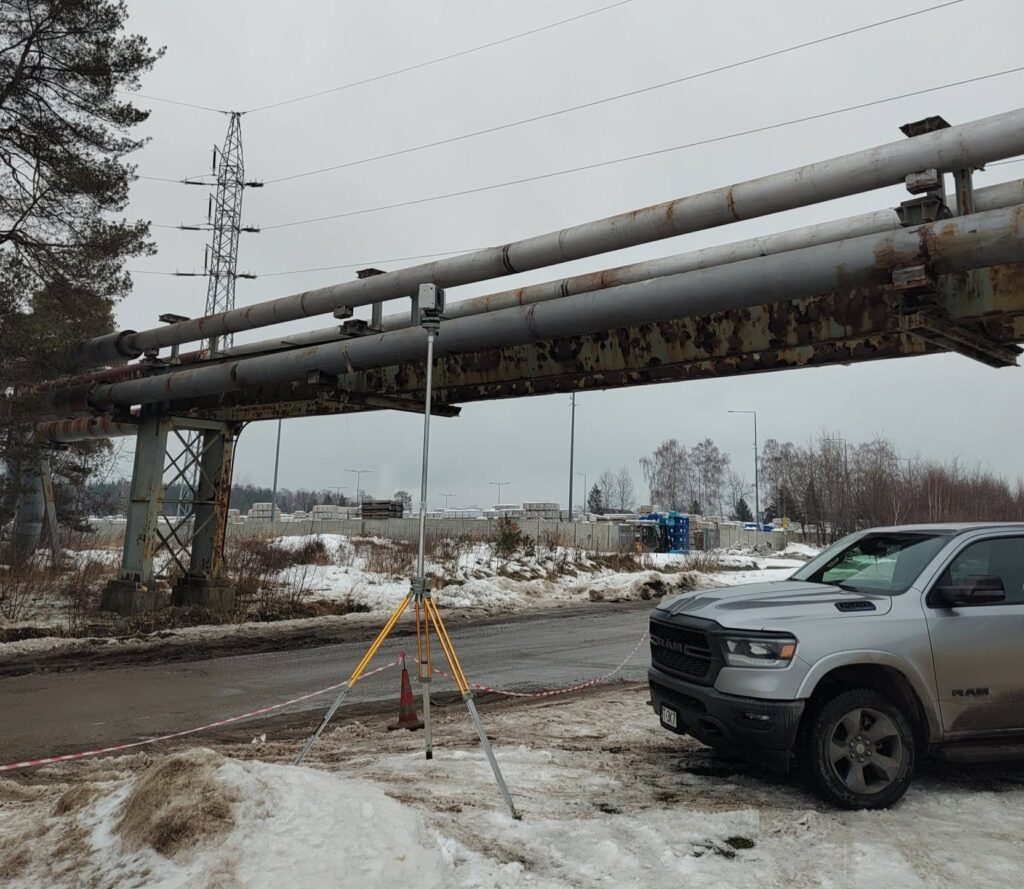
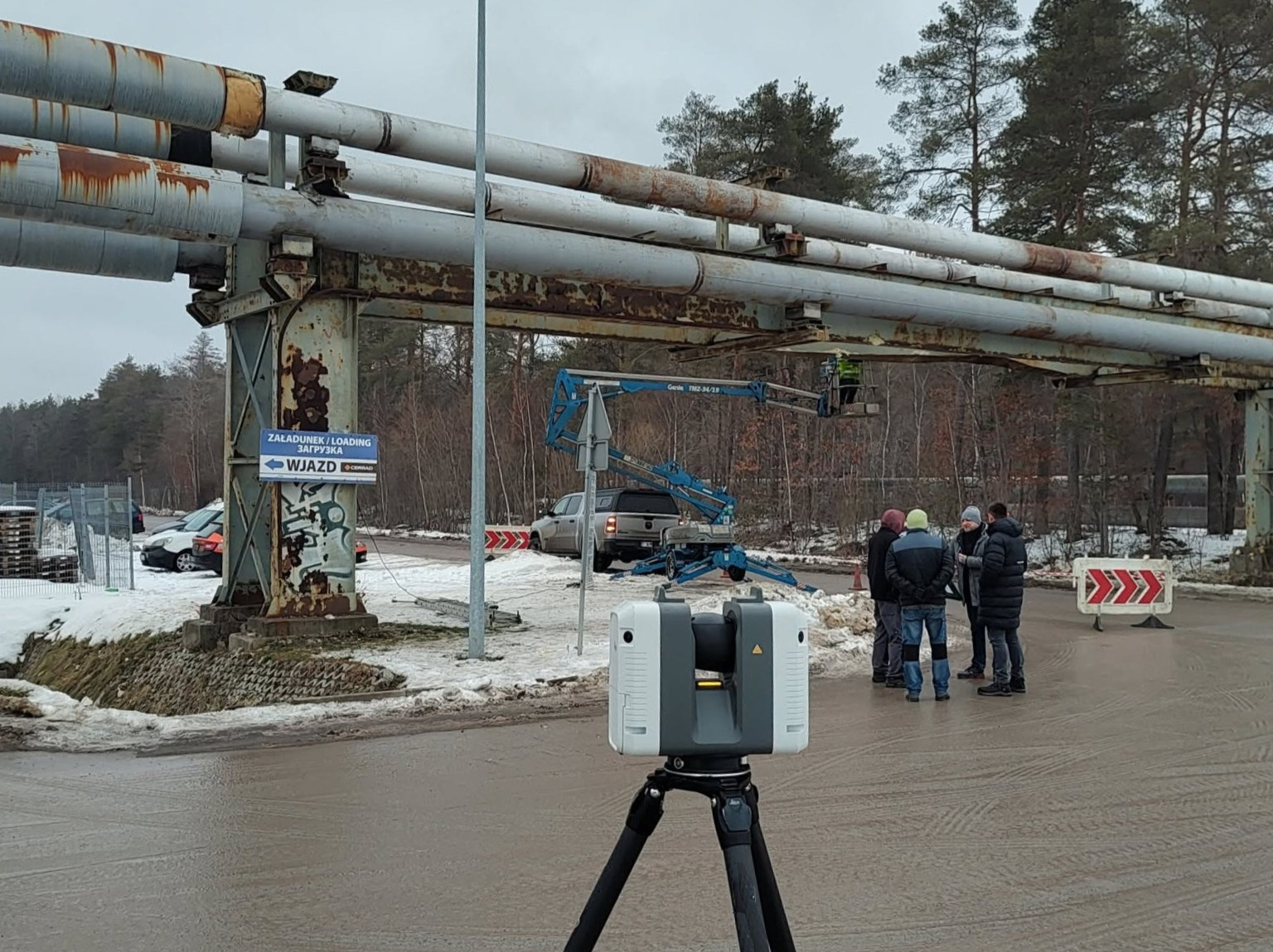
Once the area had been prepared and the surveyors had planned the placement of the equipment, the scanning began. During the survey, special extensions were used for the heavy-duty elevating tripod.
Scanning using the extension to the heavy-duty elevating tripod.
3Dsurvey processing
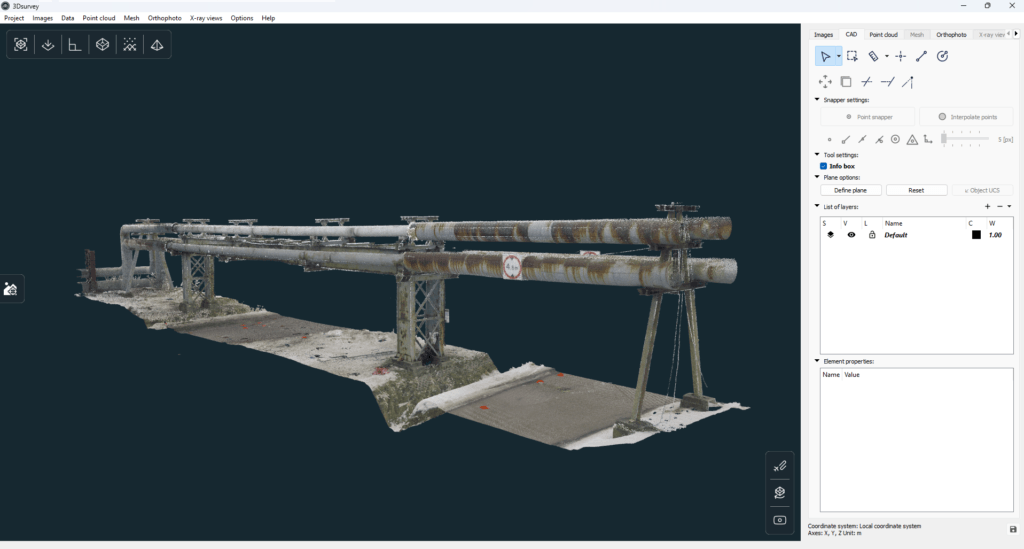
At first glance, only the metal structure appeared to be damaged, but the pipeline seemed intact. A safety inspection was carried out to evaluate the actual damage and hazard risk.
Point cloud imported to the 3Dsurvey software.
Before starting scanning, the surveyors already knew where cross-sections needed to be created.
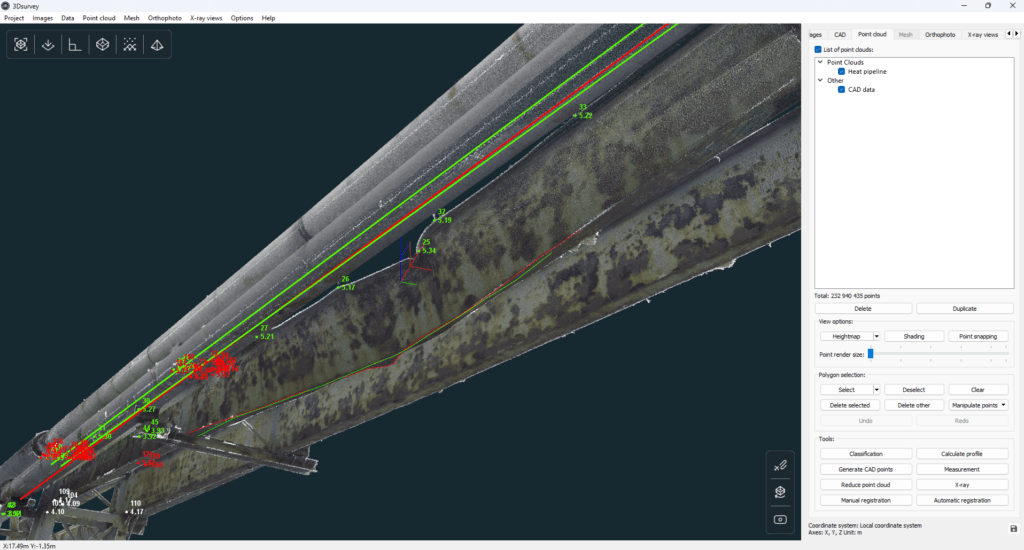
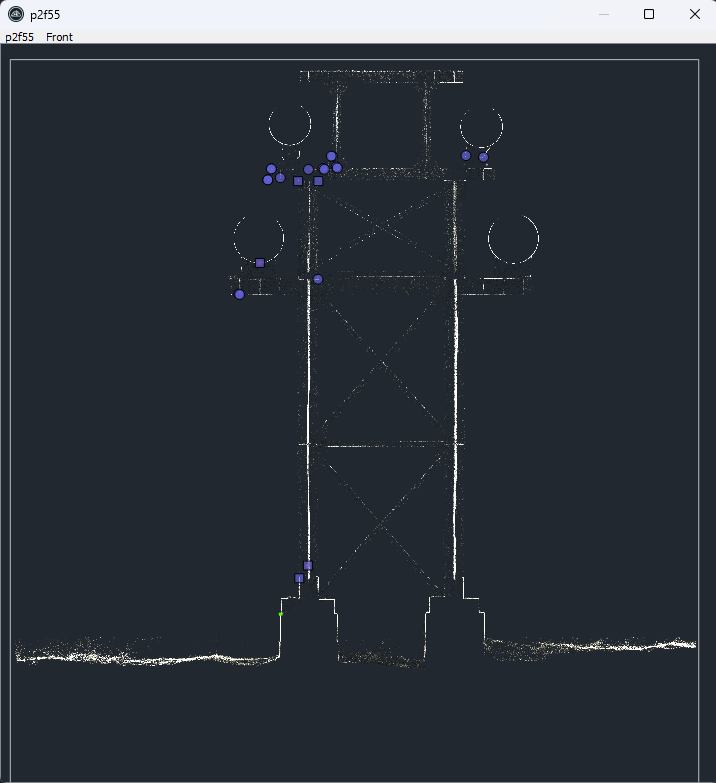
After importing the point cloud into the 3Dsurvey software and drawing the cross-section lines, the next useful step was to highlight key elements. Both the indentation caused by the car and the main shape of the heat pipeline were highlighted. This helped to identify them in the X-ray views.
The marked indentation of the metal structure.
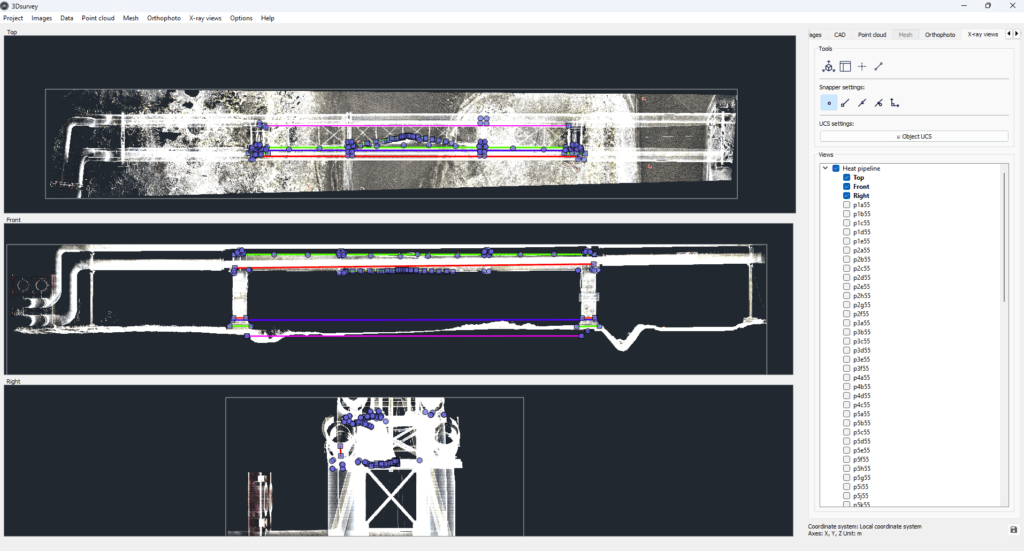
The next part of the processing took place mainly in this tab. The resolution was set to 0.10cm/px and the color transparency to 55%.
The view of X-ray tab in 3Dsurvey.
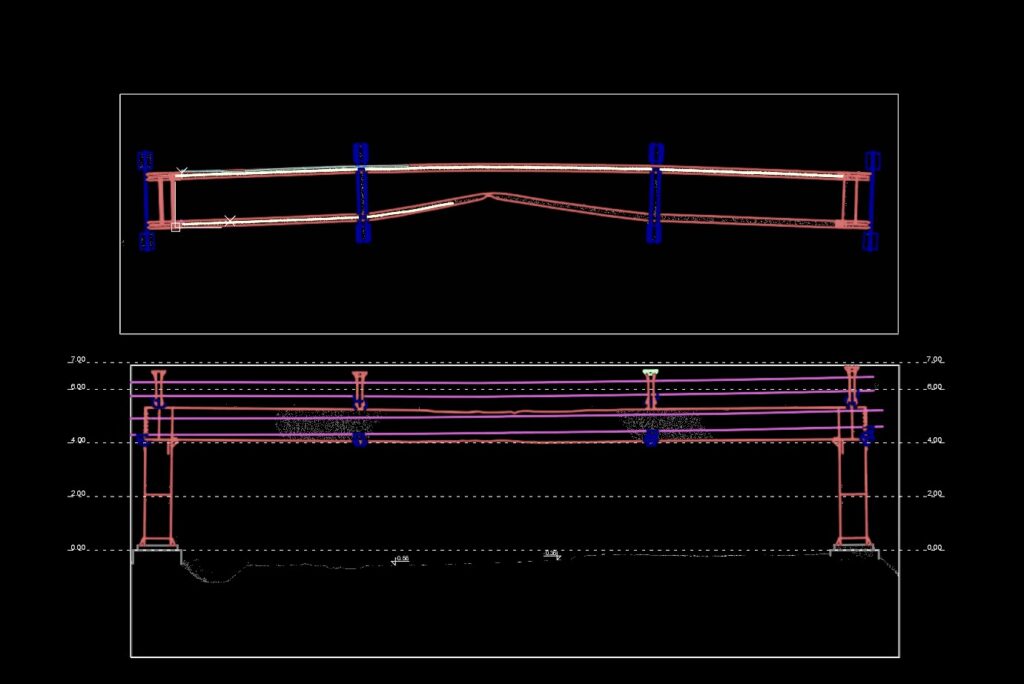
The offsets have been adjusted to the section lines. It was very important to achieve a really thin cross-section. The ability to quickly recalculate the view proved to be an extremely useful feature during this work. This allowed the team to change the offsets with just a few clicks whenever something was obscured, which significantly improved the whole workflow.
An example of a cross-section in 3Dsurvey.
Depending on the structure and specifications, these parameters may prove insufficient for other projects.
In the CAD tab, the point cloud was supplemented with lines, showing the object’s previous appearance. This made it possible to quickly measure distances and check the heights of individual elements.
The final result included:
Several cross-sections at specified locations
An outline of the damaged metal structure
And the entire object
Additional surveys
This is not a routine safety inspection, but a very important analysis. It enabled the scale of damage to be evaluated and a repair plan to be developed. The pipeline was inspected by specialists, who found no safety hazards.
Following the repair of a metal structure, it is mandatory to carry out an as-built survey. Not only does this make it possible to collect the actual data required for future routine safety inspections, but it is also essential to prevent a reoccurrence of the accident.
In addition, once the structural repair work has been completed, new road signs indicating the clearance height will be placed in front of the pipeline, and an overhead clearance bar will be installed.
This is also a task for the surveyors team. Detailed surveys using the LiDAR technology and total station are necessary to obtain accurate dimensions and easily calculate the safe space under the engineering structure.
The final view of the aboveground heat pipeline inspection.
Conclusion
Fortunately, this time only the truss structure was damaged. Nevertheless, the pipeline also required a safety inspection due to the risk of microdamage invisible to the naked eye.
For this type of work, 3D scanning technology is ideal and saves time. A dense point cloud captures every detail, making fieldwork simpler and faster.
Data processing in 3Dsurvey is easy and the software has a truly user-friendly interface. It is an extremely useful tool for a successful safety inspection.