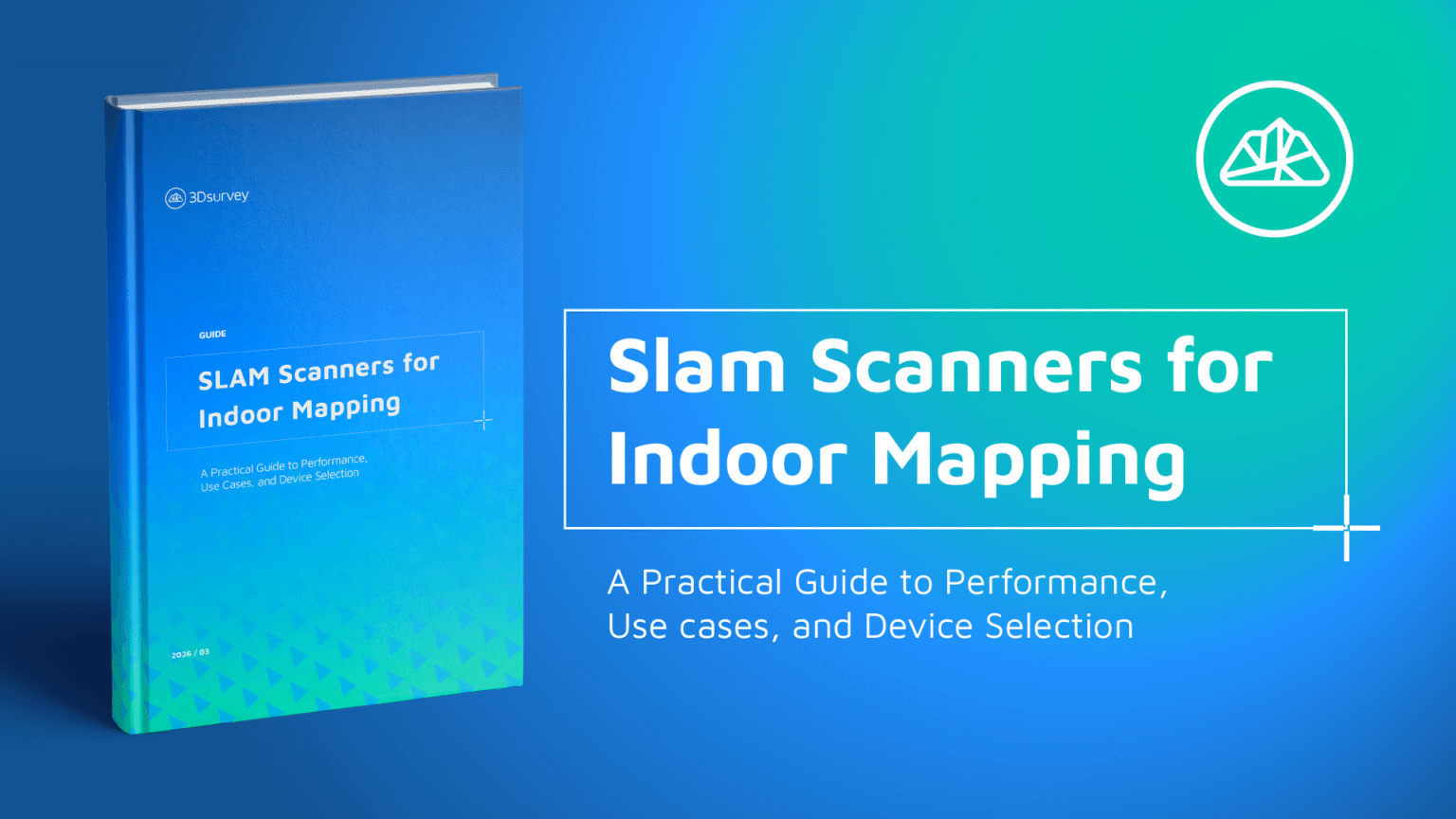
Access our Practical Guide to Indoor SLAM Performance, Use Cases, and Device Selection
Indoor environments have always been challenging for traditional photogrammetry. Without GNSS signals, with limited lighting, and often repetitive or featureless surfaces, capturing reliable data can quickly become slow and inefficient. Maintaining sufficient image overlap, avoiding motion blur, and ensuring consistent alignment can significantly increase both field time and processing effort.
This is where SLAM (Simultaneous Localization and Mapping) technology truly proves its value.
In our new practical guide, we explore how SLAM scanners are changing the way professionals capture indoor environments. Building on our earlier evaluation of seven different SLAM devices, we take a closer look at why indoor mapping has become one of the strongest applications for this technology.
The guide explains how SLAM systems simplify data capture in GNSS-denied environments while delivering dense, consistent point clouds even in low-light conditions. Instead of relying on feature detection like photogrammetry, SLAM scanners use laser measurements and real-time positioning to map interiors quickly and reliably.
Download the Guide to Access:
-
Why indoor mapping is uniquely suited for SLAM technology
-
The most common indoor SLAM use cases
-
What specifications actually matter when selecting a SLAM scanner
-
A side-by-side comparison of eight popular SLAM devices across different market tiers
-
Practical insights from real device tests, including:
- Indoor performance in real-world environments
- Data quality and scanning consistency
- Typical use cases where each device performs best
- Limitations and operational considerations
- Our final indoor verdict for each scanner